
Contact Us
Send us a message
Jeg mangler stadig `/teambuilding/udendors-teambuilding/` i tabellen. Jeg antager `https://mev.dk/en/team-building/outdoor-team-building/` — er det korrekt?
Her er resten med alle kendte links opdateret:
Indoor teambuilding covers collaborative activities that take place in controlled settings, where the focus is on dialogue, collaboration, problem-solving and shared experiences. It creates opportunities for engaging experiences where participants work closely together on tasks that require overview, communication and creative thinking.
Space is often more limited than with outdoor activities, which means tasks are typically built around problem-solving rather than physical movement. Participants work with puzzles, scenarios and challenges where the solution is found through collaboration, reflection and collective effort.
Unlike more physically demanding activities, indoor settings make it possible to work with detailed scenarios and narratives where participants can immerse themselves and actively apply their different skills throughout the process. This creates a dynamic where everyone can contribute, and where collaboration becomes clearly visible in practice.
Indoor activities are often used as part of meetings, conferences, kickoff days or company events where an engaging break is desired — one that brings participants together around a shared experience and strengthens relationships within the group.
If you would like to learn more about alternative activities that are not indoors, you can also read more about OUTDOOR TEAMBUILDING and for general information see more about TEAMBUILDING
Indoor teambuilding offers a flexibility that makes it easy to integrate activities into existing programmes and venues. Activities can be held in meeting rooms, conference facilities, canteens, warehouse spaces or event venues, where the surroundings support the experience.
Activities are protected from wind and weather, which makes them a popular choice during the winter season or in situations where you do not want to depend on the weather. If there are no obvious outdoor options nearby, indoor activities can also save time by reducing the need for transport and changing.
The controlled setting makes it possible to work with complex scenarios and tasks where participants can focus on collaboration and process. At the same time, indoor activities allow for intense experiences where participants work closely together and experience how their collective effort produces results.
There may also be practical considerations. Venues often need to serve multiple purposes such as meetings or dinner, or there may be additional costs for room hire. In these cases, flexible solutions such as ESCAPE THE BOX can be an advantage, as the activity can be integrated directly into existing settings. Alternatively, an external venue such as ESCAPE ROOM IN COPENHAGEN can provide a clear and dedicated framework for the experience.
Indoor teambuilding offers a range of benefits that make it an obvious choice in many contexts. The controlled setting makes it possible to create high-quality, focused activities where participants can concentrate on collaboration and the experience without distractions from the surrounding environment.
One of its greatest strengths is flexibility. Indoor activities can be integrated directly into existing programmes such as meeting days, conferences or company events, and typically require only minimal setup. This makes planning straightforward and allows for an engaging break to be created at any point during the day.
The activities are also independent of wind and weather, which makes planning more predictable and makes indoor teambuilding an obvious choice during winter months or on days when you want certainty that the event will go ahead regardless of conditions.
The close-quarters setting also makes it possible to work with scenarios and tasks where participants collaborate intensively and experience how their collective effort produces results. This creates a clear sense of shared focus and strengthens participants’ understanding of the value of collaboration.
Indoor teambuilding also offers the opportunity to bring all participants together in one shared space, where everyone engages with the same experience at the same time. This creates a common reference point and a natural starting point for dialogue and shared reflection afterwards.
For many companies it is also a practical solution, as activities can be carried out close to the workplace or at an event venue, minimising travel time and making it easy to integrate the experience into the programme.
Indoor teambuilding is particularly valuable in situations where you want an engaging shared break that can be integrated directly into the day’s programme without changing the setting or venue. This makes it ideal as part of meeting days, conferences, kickoffs or company events where participants are already gathered in one place.
During cooler weather or changing seasons, indoor activities are an obvious choice, as the setting is stable and independent of the weather. This makes planning more predictable and ensures the experience can be delivered at the same quality regardless of the time of year.
Indoor teambuilding also works well when you want activities with high levels of involvement and concentration, where participants work closely together on tasks that require overview, dialogue and shared decision-making. The close-quarters setting often creates an intense dynamic where collaboration becomes clearly visible, and where participants experience a strong sense of collective progression through the tasks.
Indoor activities also bring participants together around a shared experience without the need for transport or longer breaks in the programme. This makes it easy to create an energising element that can serve as a natural highlight during the day or as a shared opening before a subsequent dinner or social segment.
Indoor teambuilding is about creating a setting where participants work together on concrete tasks and experience how collaboration works in practice. Through shared challenges, dialogue and decision-making, a collective experience emerges where relationships are strengthened and participants gain a common reference they can carry forward.
Many activities are built around scenarios and investigative tasks where participants must collaborate to reach a solution. These may involve tasks requiring overview, creativity, communication and coordination, with everyone contributing their different strengths along the way.
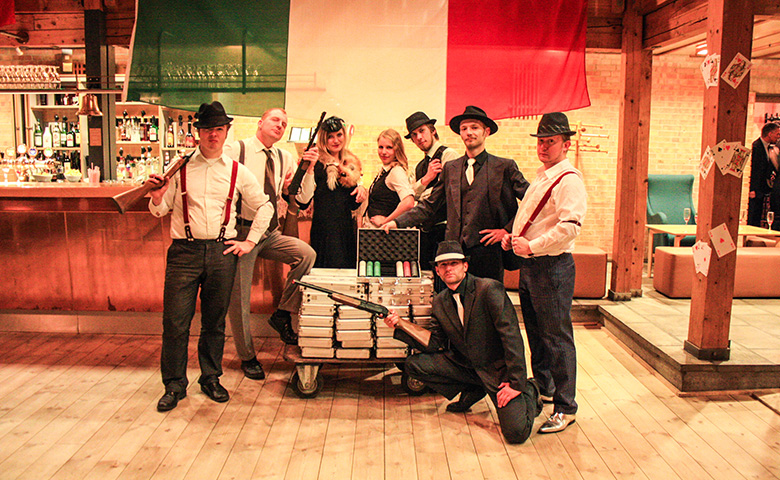
A classic example is GODFATHER CLUEDO, where participants work to solve puzzles, coordinate their investigation and draw on each other’s strengths to reach a shared solution. Here it becomes clear how collaboration and communication influence the outcome, and how different perspectives can lead to better solutions.
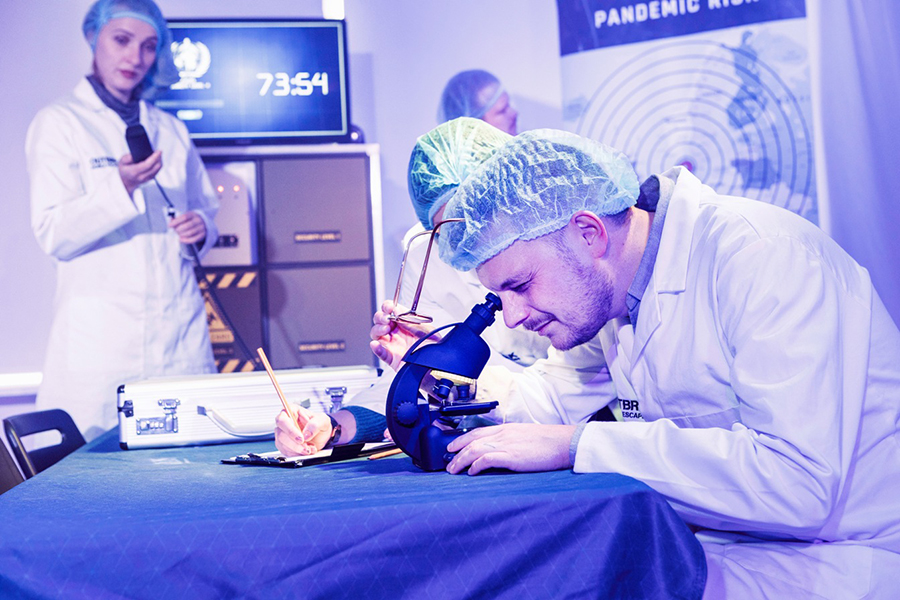
Other activities create an intense shared experience through scenarios with time pressure and collective missions. In OUTBREAK as a MOBILE ESCAPE ROOM, participants work together to solve tasks and find clues, where creativity, collaboration and shared overview are essential to success.
ESCAPE THE BOX allows participants to work in smaller teams, where each group faces a concrete challenge involving locks, puzzles and tasks that must be solved through collaboration and coordination. The activity can be integrated directly into meeting rooms or conference settings and creates a highly engaging shared experience.
At external venues such as ESCAPE ROOM IN COPENHAGEN, the setting becomes an active part of the experience. Participants work together in scenographic surroundings where tasks require creativity, collaboration and shared problem-solving under time pressure.
What all of these activities have in common is that participants depend on each other to succeed, and that the experience creates a clear understanding of how collaboration, communication and shared focus lead to better results.
With many years of experience and a large number of events delivered since the year 2000, Midgaard Event is among the most experienced providers of teambuilding in Denmark. Our concepts have been developed and refined over many years to ensure they work reliably and engagingly in practice for both small and large groups.
Indoor teambuilding is an area where we have particularly extensive experience, including in connection with meeting days, conferences and social events where activities need to fit naturally into the day’s programme and setting.
Behind every activity is an experienced team of actors, facilitators and coordinators who ensure professional delivery and a high-quality experience in both content and execution. Our approach is based on active events where collaboration plays a central role and participants are genuinely engaged throughout.
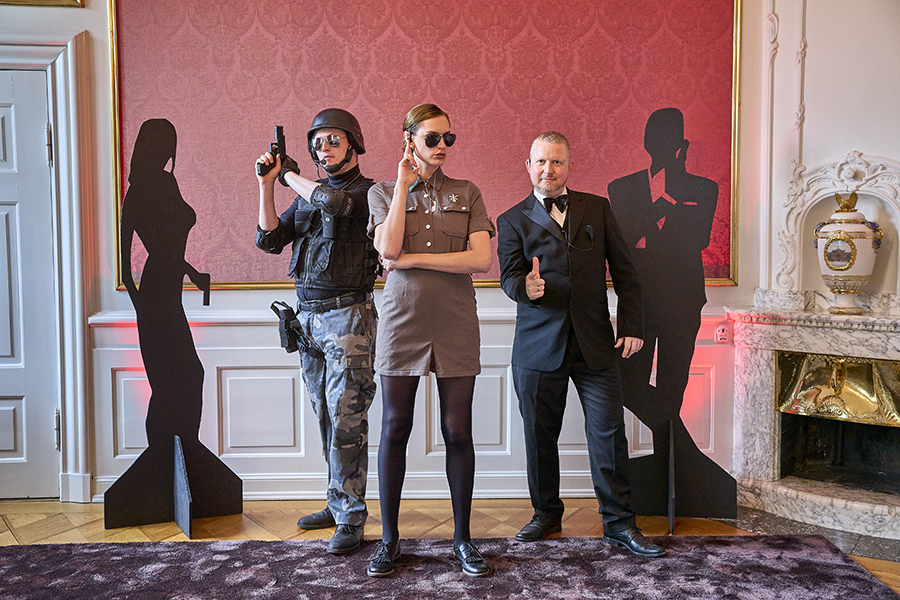
We have developed a wide range of indoor concepts, including activities based on street games, investigative tasks and murder mystery dinners, where participants work together to solve challenges with a clear narrative thread running through the entire experience.
Storytelling and coherence are an important part of our method, where tasks and missions are tied together in a narrative that creates direction and engagement throughout the activity.
We work with a wide range of conference centres, hotels and event venues where delivering great experiences while respecting the setting is essential. Many locations have unique characteristics or historic surroundings that require care and professional handling.
Thorough planning, high standards of service and clear contingency plans are a natural part of how we work, so that your event can be delivered smoothly and professionally — even if unexpected situations arise.
We are based in Copenhagen but deliver indoor teambuilding across the country, always tailoring the solution to the participants, purpose and setting.
Indoor teambuilding activities offer great flexibility in terms of where the event can be held, making it possible to tailor the experience to the purpose, number of participants and practical setting. Activities can be integrated directly into existing programmes and typically require only minimal setup, making them straightforward to plan and deliver.
Activities can be held in meeting rooms, conference facilities, canteens, warehouse spaces or event venues, where the setting supports the experience. The controlled environment makes it possible to work with scenarios and tasks where participants can focus on collaboration and process without having to account for weather or transport.
Indoor activities also create opportunities for intense experiences where participants work closely together and experience how their collective effort produces results. The format can be adapted to both short segments and longer programmes, and activities can be integrated before, during or after other scheduled elements.
Meeting rooms and breakout rooms are well suited to collaborative activities where participants work in smaller teams on investigative tasks and scenarios. Activities can be integrated naturally as part of a meeting day or workshop.
In restaurants and function rooms, teambuilding can be included as a shared element before or during dinner, creating a smooth transition between parts of the programme. It provides a social and informal setting where participants come together around a shared experience.
The canteen offers plenty of space for activities with multiple teams and can easily be transformed into an active arena for collaboration and shared challenges. It is a flexible solution where participants are in familiar surroundings.
Office spaces can be used for scenario-based activities such as GODFATHER CLUEDO, where participants move around and work on tasks across different zones. This creates an unusual experience in a familiar environment.
Large warehouse spaces allow for activities with plenty of room and flexible setup. Even more movement-based activities such as THE CHALLENGE can be run here for those wanting an indoor solution with space for energy and activity.
Sports halls offer plenty of space and the ability to work with larger groups, where activities can be scaled and adapted to the number of participants. This creates a dynamic setting with room for collaboration and movement.
Hotel rooms can be used for mobile escape room experiences, where smaller groups work intensively on tasks in a compact and focused setting. This creates an immersive experience with high levels of involvement.
An underground car park can create a raw and distinctive atmosphere for scenario-based activities or mobile escape rooms. The surroundings can help support the mood and intensity of the experience.
Tents provide a flexible indoor solution where activities can be delivered regardless of weather and location. This is a good option for events on your own premises or for temporary arrangements.
Indoor teambuilding can be adapted to many types of events where you want to bring participants together around a shared experience. The flexible format makes it possible to integrate activities as a natural part of the day’s programme — either as an energising break or as a central shared moment.
Whether the aim is to create a strong start, strengthen relationships or bring participants together around a common experience, indoor activities can be tailored to the setting, schedule and group.
At kickoffs and project launches, indoor teambuilding creates an opportunity to bring participants together around a shared experience where collaboration and dialogue are quickly put into play. The activities create a common reference point and a positive energy that can help strengthen collaboration in the period ahead.
Read more about teambuilding for KICKOFF
As part of a conference or meeting day, indoor activities serve as a natural break where participants get to work together in a different setting. This creates variety in the programme and generates new energy, while giving participants a shared experience that can strengthen engagement for the rest of the day.
Read more about teambuilding for CONFERENCES
Indoor teambuilding can create a smooth transition between parts of the programme and bring participants together around a shared activity before dinner or the party. The focus here is often on creating a highly engaging experience where participants collaborate across teams and gain a shared reference that adds to the atmosphere.
Read more about teambuilding for CHRISTMAS PARTIES
As part of a company party, indoor teambuilding can serve as a shared element that brings participants together and creates a natural focal point within the programme. It provides an opportunity to create a collective experience where participants collaborate and gain a common reference they can carry into the rest of the event.
Read more about teambuilding for COMPANY PARTIES
When planning an indoor teambuilding activity, it can be very helpful to clarify the practical details in advance. This provides a better basis for choosing the right activity and ensures that the event runs smoothly and without unnecessary surprises.
What facilities do we have available?
Start by getting an overview of rooms, space and practical options. Size, layout and access conditions all have a bearing on which activities will work best.
When else do we need these facilities?
Consider whether the rooms also need to be used for meetings, dinner or other programme elements. This may affect planning around setup and timing.
Has time been allowed for activity setup?
Some activities require time to set up before the start. It is worth ensuring the venue is accessible well in advance, so the experience can begin calmly and professionally.
Has time been allowed for packing down after the activity?
After the activity, equipment needs to be packed away. It is worth clarifying whether the venue can be used in the period after the event, or whether there is time pressure.
How straightforward is unloading, and does it affect setup time?
Access to the venue, distance from parking and unloading options can all affect logistics and the time that needs to be set aside for setup.
Do we need a backstage area if external suppliers are involved?
A smaller room for materials, preparation or breaks can make the event run more smoothly and provide better working conditions throughout.
Should catering for external suppliers be factored in?
For longer events, it may be relevant to plan for catering so that suppliers can work effectively throughout the programme.
Is access to the venue guaranteed throughout?
Check opening times and any restrictions so that planning can be adapted to the practical conditions around access.
Will we be leaving the venue before the activity is fully packed down?
It is worth clarifying who has access after the event and how packing down can take place without affecting the programme.
Can we run the activity without disturbing others nearby?
Consider whether there are other activities in the vicinity and whether noise levels or movement could affect the surroundings. This may influence the choice of activity.
Many companies choose to organise smaller indoor collaborative activities themselves as part of a meeting day or event. This can be a good way to create variety and give participants a shared break during the day, with a focus on dialogue, collaboration and shared experiences.
When organising activities in-house, it is often beneficial to focus on the collaborative process rather than competition alone. Exercises where participants must solve tasks together or make decisions collectively tend to deliver greater value than activities where results are measured primarily on an individual basis.
It can also be an advantage to choose activities with clear frameworks and a well-defined goal, so participants quickly understand the task and can focus on working together. This creates a sense of security within the group and provides a shared experience that everyone can reflect on afterwards.
There are, however, situations where companies choose professionally delivered activities. This is not only about saving time or simplifying planning, but very much about ensuring a high-quality experience. The activity itself is often not the largest investment — rather, it is the participants’ time. A well-crafted event sends a clear signal that participants’ time is valued.
Build a Lego structure:
A communication activity where participants are divided into smaller groups. Some participants know the finished goal and must explain to the others how the figure should be built. The exercise clearly demonstrates how important precise communication is for achieving a shared result.
Cook together:
A coordination activity with limited time and limited resources — for example, one hob or one oven. Participants must plan their efforts and coordinate so that tasks do not clash, providing a clear experience of planning and collaboration in practice.
Construction challenge:
Give groups a fictional challenge with limited resources, fragmented information and a clear deadline, where they must work together to find a solution. The focus is on dialogue, prioritisation and shared decision-making.
Indoor teambuilding provides a stable setting where activities can be delivered regardless of the weather. This makes it easy to plan and integrate into meetings, conferences or events, while giving participants an intense collaborative experience.
Indoor activities are often ideal during the winter season, for shorter programmes, or when you want to bring participants together without the need for travel. They also work well when you want tasks focused on investigation, collaboration and creative problem-solving.
Activities can be held in meeting rooms, conference facilities, canteens, offices, warehouse spaces or external event venues. The setting is adapted to suit the specific activity and group of participants.
Most indoor activities focus on collaboration, communication and problem-solving rather than physical exertion. This makes them well suited to groups with varying energy levels and physical abilities.
Yes, activities can be tailored to both the time available and the programme. They can work as short segments of 1–2 hours or as a larger part of the day, depending on the purpose.
Indoor teambuilding can be scaled to suit both small teams and larger groups. Activities are typically organised in teams so that all participants are involved and play an active role in the experience.
Yes, many choose to integrate activities as part of a meeting day or as a shared element before or after dinner. This creates variety in the programme and gives participants a shared experience.
No, the activities are also used for events with clients, partners and networks, where a shared experience can strengthen relationships and dialogue.
Indoor activities typically focus on investigation, scenarios and collaboration in controlled settings, while outdoor activities generally offer more movement and energy through practical challenges.
Duration varies from short sessions of around an hour to longer programmes depending on the type of activity and the schedule. Many of Midgaard Event’s indoor activities run for 2 hours.
Yes, activities can be adapted to the purpose, group and desired experience, so they support the outcomes you want to create.
The price depends on the type of activity, duration, number of participants and setting. The largest investment is often participants’ time, while the activity itself creates a valuable shared experience. Midgaard Event’s activities start from approximately DKK 125 per person, which is the lowest price for ESCAPE THE BOX.
Indoor teambuilding can bring participants together around shared challenges and create energy and collaboration across roles and teams.
The right activity depends on your purpose, setting and the experience you are looking for.
If you would like to hear more about the options or get some advice, get in touch and we will be happy to help find the solution that best fits your goals.
Contact us for a no-obligation quote for your next event. Use the contact form or reach us at in**@*ev.dk or (+45) 33 23 95 75.