Create good relationships through experiences where teamwork, communication and coordination are the keys to success
Our team building activities create energy, stronger collaboration and shared experiences that can be felt long after. Common to our concepts is that teamwork is the key to success, and that all participants become active players along the way. The activities are well-prepared and designed for high involvement, so team spirit, commitment and good laughs occur naturally. Click through and find the activity that suits you best.

Contact Us
Send us a message
Team building covers structured activities where a group works together on tasks that require cooperation, dialogue and joint decisions. The purpose is not just to solve a task, but to create an experience where participants gain insight into each other’s strengths, roles and ways of contributing to the community.
In modern organizations, team building is used as an active tool to strengthen relationships and create better interaction in everyday life. When people meet in a different setting than the daily work rhythm, new perspectives often arise because habits are broken up and teamwork takes on new forms.
Team building can take many forms and purposes. Sometimes the focus is on the shared experience, where the participants through fun challenges and joint victories experience team spirit, laughter and a stronger community. Here, it’s about shaking the group together and creating energy through experiences that bring people closer together.
Other times, team building is more targeted at collaborative processes, communication and concrete outcomes, where the activities give the participants new perspectives on their way of working together. Here, the experience can serve as a common starting point for reflection and learning.
In practice, team building often spans both approaches, where experience and content go hand in hand. This provides the opportunity to create activities that both engage, unite and at the same time provide value in the form of stronger relationships and better interaction in the group.
When people work together on a common task in a new setting, a different dynamic often arises than in everyday life. New roles emerge, communication becomes clearer, and participants get the opportunity to experience each other in new ways. It is precisely this change in framework that makes team building an effective tool for strengthening collaboration.
An important factor is that the activities are typically not directly work-related. When the tasks are outside the participants’ daily roles, the focus shifts from professional position to the collaborative process. This makes it easier to be open, curious and investigative in relation to how to work together and how different strengths are brought into play.
The delimited framework of an activity also provides a clear start and end, where everyone participates in the same experience. This creates a common starting point where the participants can see a result that they can relate to, either as learning or as a shared experience that strengthens the community and relationships in the group.
When the participants work together on specific challenges, it becomes clear how the collaboration works in practice. The focus is shifted from individual performance to collective output, where the group’s combined effort creates a result that is greater than the sum of the individual contributions. In a good collaborative process, 2+2 becomes not just 4, but 2+2=5, because the participants strengthen each other and create a result that none of them could have achieved alone.
That is precisely why many team building activities are based on tasks where the participants are dependent on each other to reach the goal. It strengthens the experience of shared responsibility and provides a natural understanding of how collaboration, communication and common focus can create better results.
Team building can take place both indoors and outdoors, and the difference is often both about the practical framework and the type of experience you want to create. Both forms can strengthen cooperation and community, but they provide different types of dynamism and energy in the group.
In practical terms, indoor activities can be held in many types of rooms, such as training centres, meeting rooms, warehouses or directly at the workplace. This makes indoor team building flexible and easy to integrate as part of a meeting day or event. Outdoor activities, on the other hand, require access to nature, lawns or forests, or an exciting city where the surroundings can be included as part of the experience.
The difference also lies in the type of tasks. Indoor activities are often built around brain exercises, cooperation and communication with limited physical activity. Here, the participants typically work with mysteries, puzzles or scenarios where the task has a concrete answer or a solution that the group must arrive at together.
Outdoor activities are typically more active and allow participants to move and get some fresh air. The tasks can be practical or mission-based, and the result of the effort is often more physical and visible, which can provide a different type of energy and motivation in the group.
The choice between indoors and outdoors is therefore a matter of setting, energy and purpose. Sometimes it makes sense to choose one approach, other times a combination can create a good balance between focus, movement and shared experiences.
Read more about the possibilities for INDOOR TEAM BUILDING and OUTDOOR TEAM BUILDING.
In practice, team building is about creating a framework where participants work together on specific tasks and experience how collaboration works in reality. It is through common challenges, dialogue and decisions that relationships are strengthened and that the group has a common experience that can be taken forward.
Many activities are built around scenarios and missions where participants must work together to reach a solution or complete a task. It can be tasks that require an overview, creativity, communication or coordination, where everyone contributes with different strengths along the way.
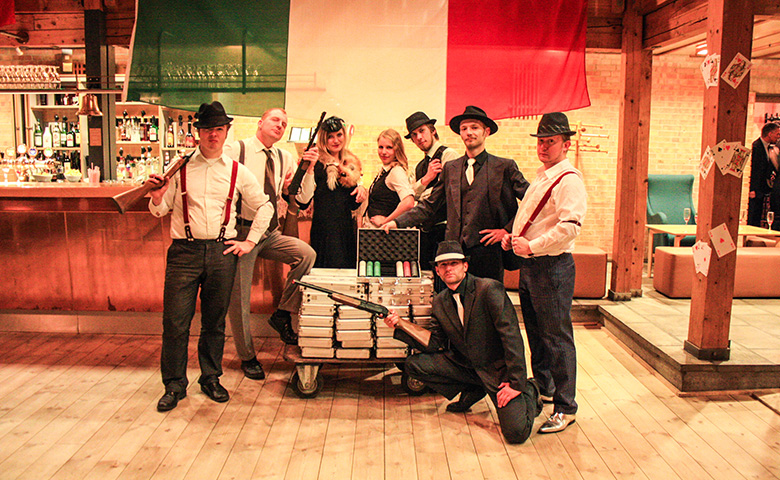
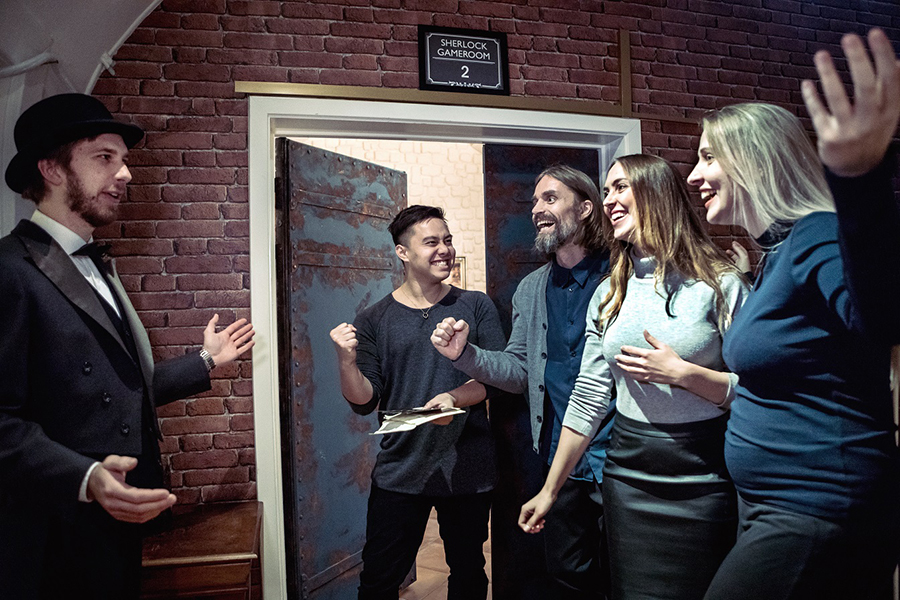
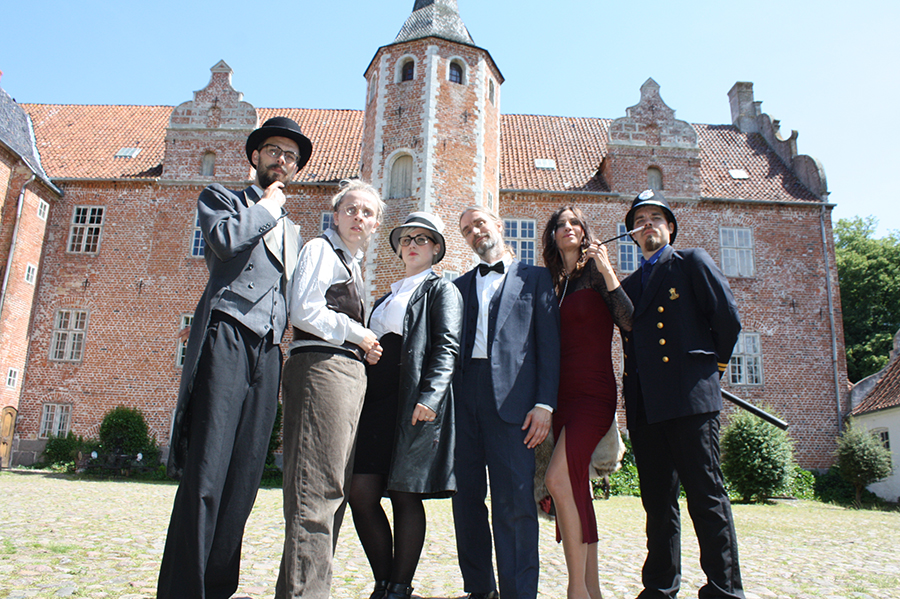
A classic example is collaborative activities with puzzles and mysteries, where the participants must find answers together through creative tasks, where different angles and perspectives often give better results. In GODFATHER CLUEDO, the participants work to solve puzzles, coordinate their investigation and bring each other’s strengths into play to reach the common solution. Here it becomes clear how collaboration and communication affect the result.
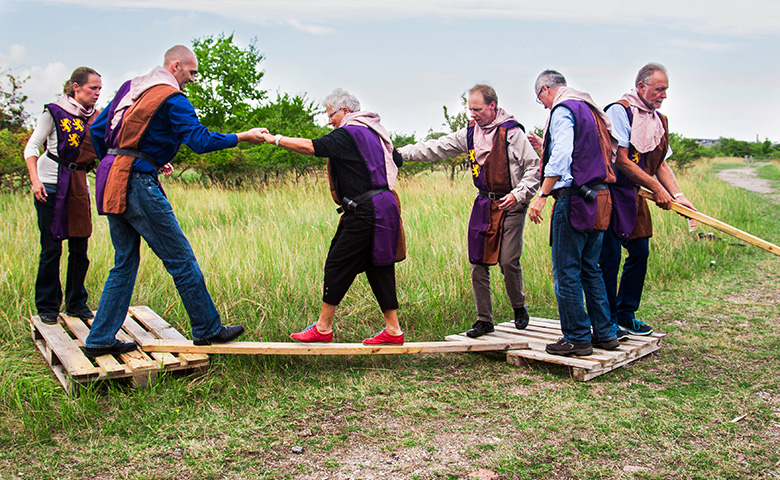
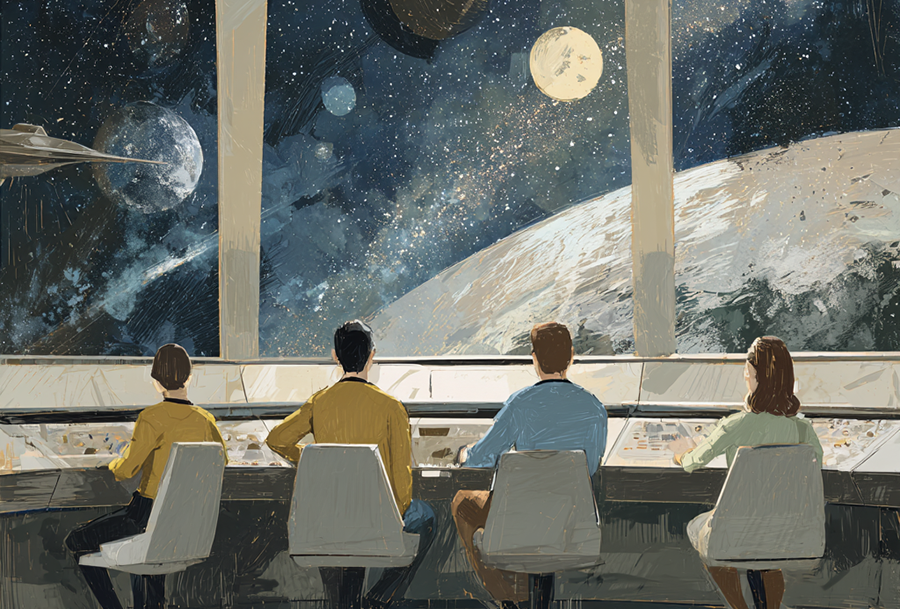
Other activities are based on movement, where the interaction between overview, coordination and communication are key pieces in solving the tasks with bravura. The energy and collaboration arise through commitment and the right mix between planning and execution. In THE CHALLENGE, the teams work together in active disciplines, where common strategy and cooperation are crucial to success, and where the experience creates both energy and team spirit.
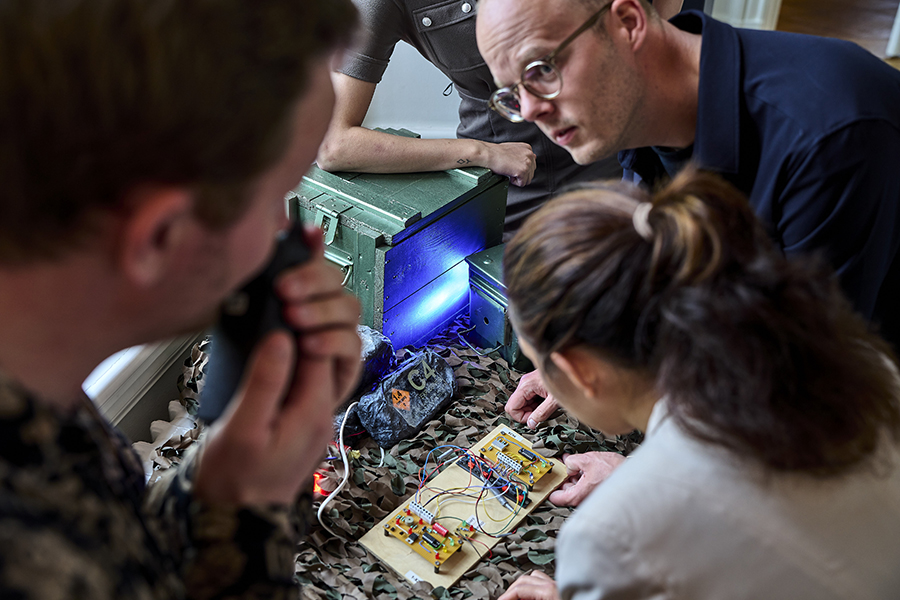
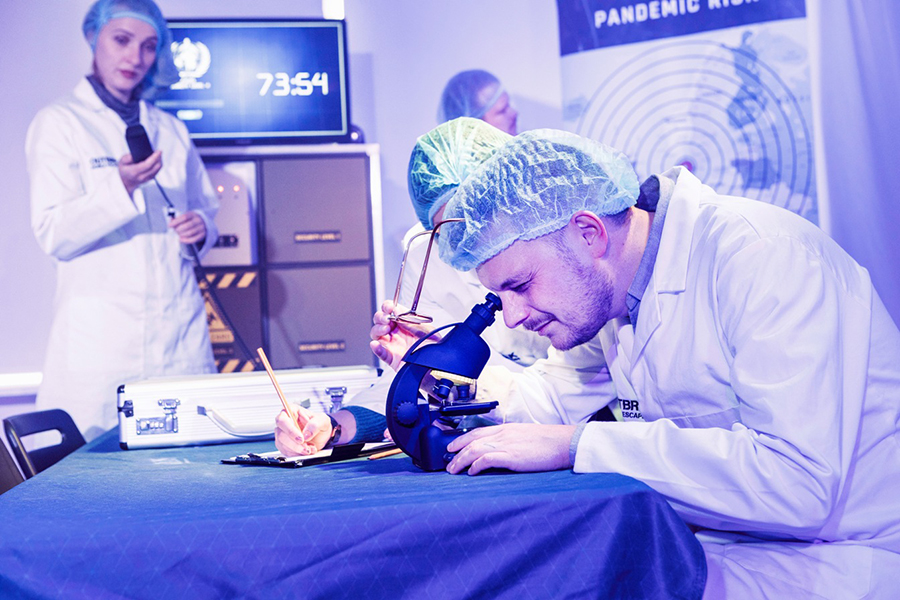
Team building can also take the form of scenario-based experiences, where participants work together to solve a common mission. For example, it can be OUTBREAK as a MOBILE ESCAPE ROOM or experiences in an ESCAPE ROOM IN COPENHAGEN, where the tasks require cooperation, creativity and joint problem solving under time pressure to reach the goal.
Common to the activities is that the participants are dependent on each other to succeed, and that the experience creates a common reference that can strengthen both cooperation and community afterwards.
Midgaard Event is one of Denmark’s most well-established team building agencies with experience from more than 100 events a year since the year 2000. Through many years of work, we have developed our concepts so that they are thoroughly tested, refined and created to work in practice for both small and large groups.
Our team consists of an experienced staff of skilled actors, directors and coordinators, all of whom work to create engaging experiences with high quality in both content and execution. We specialize in active events where collaboration is a central part of the experience, and where the participants are involved rather than just being spectators.
A strong narrative focus is an important part of our approach, where tasks and missions are tied together by a clear red thread that gives meaning and direction throughout the activity. At the same time, we place great emphasis on high service, thorough planning and backup plans that minimize the risks of both illness and unforeseen events.
We are headquartered in Copenhagen, but conduct team building throughout Denmark and always adapt the solution to the framework, purpose and participants.
Team building can be included in many types of events and contexts, and the form can be adapted to both the setting, participant group and purpose. Sometimes it’s about creating energy and community, other times it’s about gathering the participants around a shared experience during the day or as part of a festive setting.
At kickoff and project start, team building can help to gather the participants around a common direction and create a good start to a new collaboration. When the participants work together on a common task, relationships and a common reference are quickly created, which can help strengthen the collaboration in the future.
Read more about team building for KICKOFF
As part of a conference or meeting day, team building can serve as an energy-filled break, where participants get the opportunity to work together in a different setting. It can create new energy in the group and give the participants a shared experience that strengthens engagement for the rest of the day.
Read more about team building for CONFERENCE
At summer parties and social events, team building can create a shared experience where participants collaborate across disciplines and experience each other in new roles. Here, it is often about creating an informal framework where community and good experiences are in focus.
Read more about team building for SUMMER PARTY
As part of a company party, team building can function as a joint feature that gathers the participants around an activity and creates a shared experience before the party continues. This can provide a good transition between program parts and strengthen the community across the organization.
Read more about team building for CHRISTMAS PARTY
As part of a company party, team building can function as a joint feature that gathers the participants around an activity and creates a shared experience before the party continues. This can provide a good transition between program parts and strengthen the community across the organization.
Read more about team building for CORPORATE PARTY
Many companies choose to arrange smaller collaboration activities themselves as part of a meeting day or an internal event. It can be a good way to create variety in the program and give the participants a joint break during the day. Simple exercises can work well, especially when the purpose is to create energy, dialogue and a shared experience in the group.
When you organize activities yourself, it is often an advantage to keep the focus on the collaboration process rather than the competition alone. Exercises where the participants have to solve tasks together or make decisions together typically provide greater value than activities where the results are primarily measured individually.
At the same time, it can be an advantage to choose tasks with a clear framework and a clear goal, so that the participants quickly understand the task and can focus on the collaboration. It creates a sense of security in the group and provides a shared experience that everyone can relate to afterwards.
However, there may be situations where companies opt for professional activities. It’s not just about saving time or making planning easier, but very much about ensuring a high quality experience. The activity itself is often not the largest investment, but is the participants’ time. Regardless of whether the participation is part of working hours or leisure time, a well-prepared event sends a signal that the participants’ time is valuable.
Professional activities are based on experience from many executions, where exercises and scenarios have been continuously improved and fine-tuned. As an event agency, we work with the same event types over and over again, which makes it possible to develop quality over time and distribute investments over many events rather than a single one.
Treasure hunt in the local area:
Outdoor collaboration activity where the groups are given a number of posts or tasks that must be solved in the local area within a fixed time frame. The participants must plan the route, allocate roles and work together to solve the tasks along the way. The exercise gives energy and shows how coordination and joint decisions affect the result.
Escape room with puzzles based on the company:
Indoor activity where the participants work in small groups to solve puzzles and tasks that lead to a total solution. The tasks can consist of codes, logical challenges and small clues that require cooperation and overview. The exercise creates an intense experience with a focus on communication and joint problem solving.
Build the tallest structure:
Creative collaboration exercise where the groups are given simple materials such as paper, tape or straws and must build the tallest or most stable structure within a fixed time frame. The activity requires planning, idea development and collaboration and provides a clear experience of how different perspectives contribute to a common solution.
When you want a structured experience with clear progression and a well-thought-out scenario, a facilitated activity can provide a different depth. Here, the participants can focus on the collaboration, while the framework and process are planned in advance.
Facilitated activities can also be an advantage when you want a shared experience with high quality, where all participants are engaged and where the result is experienced as something the group has created together.
There are many options for where team building can take place, and the choice of setting often helps to shape the experience. Depending on the purpose, number of participants and type of activity, the event can be adapted to different types of locations so that the setting supports the desired dynamics and energy in the group.
Some activities take place at selected event locations that are equipped with facilities for specific types of experiences. For example, it can be experiences in an ESCAPE ROOM IN COPENHAGEN or activities in kitchens for cooking schools, where the framework is designed to support collaboration and joint tasks.
Team building can also be held indoors in rooms of the company’s own choosing. It can be meeting rooms, warehouses, canteens or office environments, where the activities are adapted to the existing framework and integrated as a natural part of the day’s program.
Outdoor activities provide the opportunity to use nature, lawns or forests as a setting for the experience. Here, the surroundings can create a different type of energy and give the participants the opportunity for movement and fresh air as part of the collaboration.
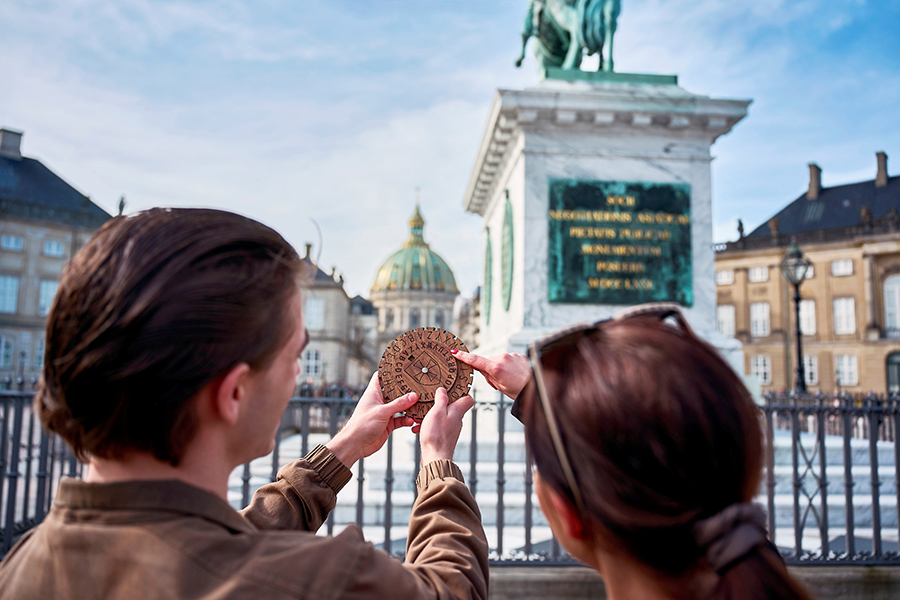
Finally, team building can also take place in urban environments, where the surroundings become an active part of the experience. Cities such as Copenhagen, Aarhus and Odense provide opportunities for activities where participants work together in the city’s space and experience the surroundings in a new way.
Read more about the possibilities for TEAM BUILDING IN COPENHAGEN
Read more about the possibilities for TEAM BUILDING IN JUTLAND
Read more about the possibilities for TEAM BUILDING IN ZEALAND
Read more about the possibilities for TEAM BUILDING IN FUNEN
Read more about the possibilities for TEAM BUILDING IN AARHUS
Read more about the possibilities for TEAM BUILDING IN ODENSE
Read more about the possibilities for TEAM BUILDING IN AALBORG
Team building is activities where employees work together on tasks or experiences to strengthen collaboration, communication, and relationships. It can be both energizing activities, collaborative exercises or shared experiences that create common references.
The purpose is to strengthen cooperation, communication and relationships through shared experiences where the participants work together on tasks or challenges. It can be about creating energy, strengthening community or providing new perspectives on collaboration.
Team building can last from short sessions of 1–2 hours to full-day events or longer courses. The duration depends on the purpose, program and how big a role the activity will play in the day.
Yes, activities can be adapted to both the framework, number of participants and purpose. It can be anything from short collaborative exercises to larger experiences with scenarios or missions.
Indoor activities often focus on cooperation, communication and problem-solving in a controlled setting, while outdoor activities typically provide more movement and energy through practical tasks and shared challenges.
Team building can be adapted to both small groups and larger organizations. In Midgaard Event, we have done team building from small teams with few participants and up to several hundred participants divided into many teams. Activities can be scaled so that everyone gets involved and experiences contributing.
Team building often provides the greatest value when the participants work together on a common task in a setting where they experience each other in new ways and get a common reference to take with them.
Team building can be held at event locations, at the company itself, outdoors in nature or in urban environments, depending on the activity and purpose.
Yes, team building can be adapted to businesses of all sizes and industries. The form and content can be adjusted to suit both small teams, larger organizations and different types of employee groups.
The price depends on the type of activity, duration, number of participants and framework. Simple activities can be relatively simple to plan, while larger experiences with facilities and scenarios require more planning.
Team building can be an experience that brings people together around common challenges, creates energy and strengthens collaboration across roles and teams. When the participants work together on a common task, relationships and common references are created, which can help create a stronger culture and a better interaction in everyday life.
The right activity depends on the purpose, the framework and the experience you want to create. Sometimes it is about bringing the participants together through a shared experience, other times it is about creating an engaging break or a common starting point for dialogue and collaboration.
If you want to hear more about the possibilities or have sparring on how team building can be included in your event, please contact us. We are happy to share our experiences and help you find the solution that best suits your goals and framework.
Use the contact form or contact us on in**@*ev.dk or 33 23 95 75 for an offer for your next event.